CityTour AI

Rome self-guided walking tour

Rome: From Ancient Power to Baroque Splendor

Discover the fascinating history of Rome on a relaxed walking tour that bridges the gap between ancient power and Baroque elegance. You will visit world-famous monuments like the Pantheon and the Trevi Fountain, while also discovering hidden Art Nouveau gems and the charming Tiber Island. Experience firsthand how ancient heritage blends seamlessly into the vibrant life of the modern Italian capital.

Audio tourSelf-guidediOS & Android
191minutes
8.1 kmdistance
18stops
Audio guideFormat
Rome: From Ancient Power to Baroque Splendor
Alvesgaspar / CC BY-SA 4.0

Stops on this route

This tour works well for first-time visitors, weekend trips, and travelers who want to explore Rome without a fixed tour time.
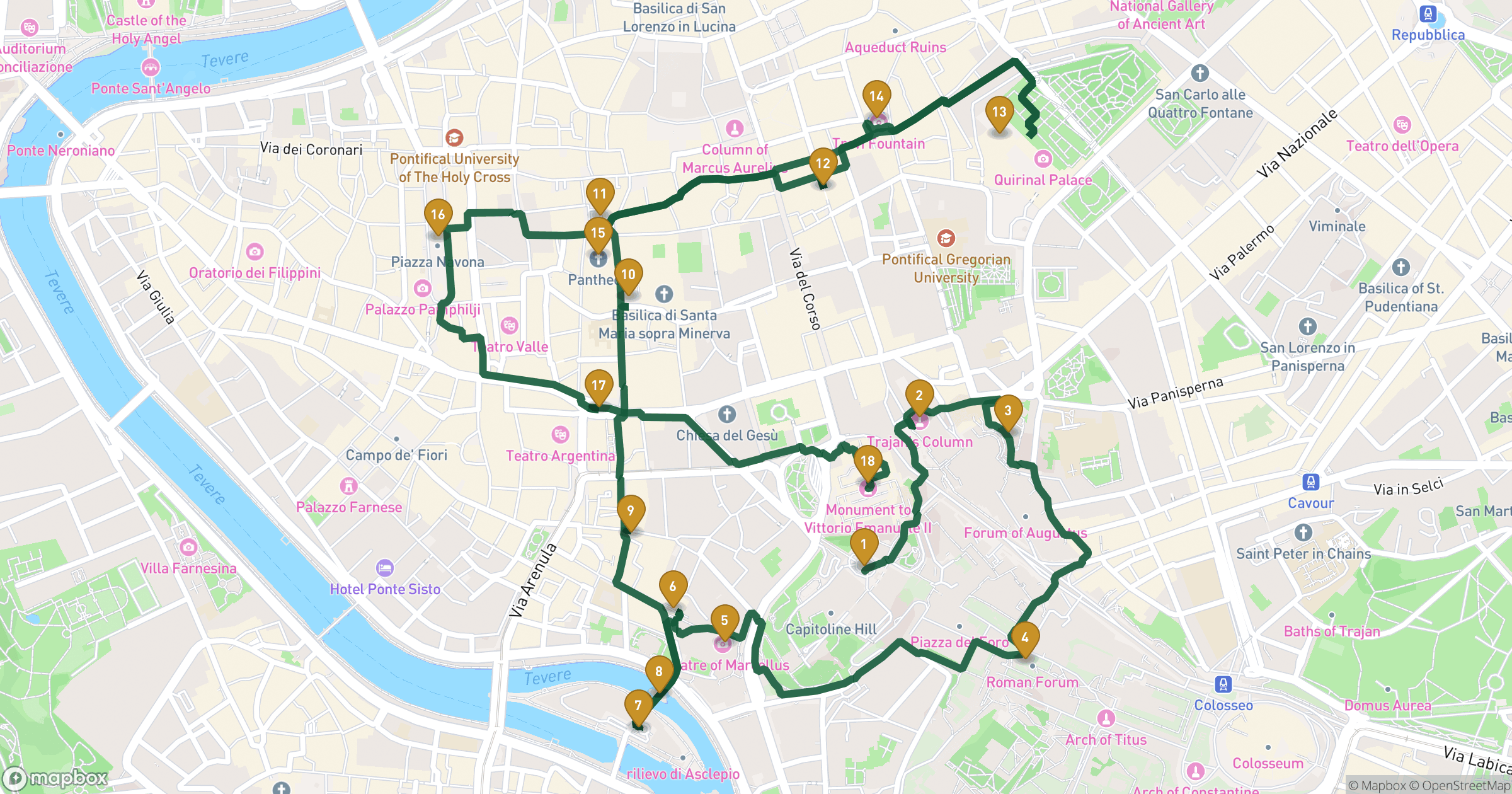
Route map for Rome walking tour

Map for Rome walking tour with 18 stops
The static map shows the tour route with Piazza del Campidoglio, Colonna di Traiano, Mercati di Traiano, Roman Forum, and 14 more stops.

Stops along the route

All stops on this self-guided tour at a glance.

  1. Piazza del Campidoglio in Rome
    Kameister / CC BY-SA 4.0

    1Piazza del CampidoglioSquare

    Michelangelo redesigned the Capitoline Hill after Emperor Charles V announced a visit in 1536, prompting the Pope to address the area's neglected state. The architect devised the Cordonata ramp so horseback riders could ascend directly to the plaza without dismounting. At the center stands Marcus Aurelius's bronze equestrian statue, preserved through the Middle Ages because it was mistaken for the Christian Emperor Constantine.

    Architect: Michelangelo · Wikidata

  2. Colonna di Traiano in Rome
    Jakub Hałun / CC BY-SA 4.0

    2Colonna di TraianoMonument

    Inaugurated in 113 AD, Trajan's Column commemorates the Roman victory over the Dacians with a 200-meter spiraling stone relief wrapped 23 times around the shaft. The carved narrative depicts over 2,500 figures and portrays Emperor Trajan himself nearly 60 times. Inside the hollow marble pillar, a spiral staircase of 185 steps ascends to a viewing platform above the base where Trajan's golden ash urn once rested.

    Built: 113 · Architect: Apollodorus of Damascus · Named after: Trajan · Wikidata

  3. Mercati di Traiano in Rome
    NikonZ7II / CC BY-SA 4.0

    3Mercati di TraianoAttraction

    Trajan's Market was built by architect Apollodorus of Damascus, whose fierce perfectionism later led to a fatal clash with Emperor Hadrian. The multilevel red-brick complex once housed over 150 tabernae selling everything from Eastern silk to fresh grain and fish. Its semicircular exedra was engineered to hold back the Quirinal Hill, creating a resilient structure later repurposed as a fortress and monastery.

    Built: 113 · Architect: Apollodorus of Damascus · Named after: Trajan · Wikidata

  4. Roman Forum in Rome
    Jean-Pol GRANDMONT / CC BY 4.0

    4Roman ForumAttraction

    The Roman Forum emerged around 600 BC after the Etruscan king Lucius Tarquinius Priscus built the Cloaca Maxima sewer to drain a swampy burial ground. Over centuries, the former marshland evolved into the civic stage for senate meetings in the Curia and impassioned orations from the Rostra platform. During the Middle Ages, the ruined paved Via Sacra fell into neglect, turning into a cow pasture known as the Campo Vaccino.

    Built: 800 BC · Wikidata

  5. Teatro di Marcello in Rome
    Fiat 500e / CC BY-SA 4.0

    5Teatro di MarcelloAttraction

    The Theatre of Marcellus was commissioned by Emperor Augustus in tribute to his nephew Marcus Claudius Marcellus, who died at age 19. At the dedication in 13 BC, the emperor was so moved that he symbolically kept an empty seat for his deceased heir. The Orsini family constructed a palace directly on top of the ancient Doric and Ionic arcades in the 16th century, creating apartments still inhabited today.

    Wikidata

  6. Portico d'Ottavia in Rome
    Rudolfo Kithera / CC0

    6Portico d'OttaviaAttraction

    The Porticus of Octavia preserves the remnants of an expansive colonnade rebuilt by Emperor Augustus for his loyal sister Octavia Minor. From the Middle Ages into the 19th century, the ruins operated as Rome's main fish market, known as the Cottio. An ancient column inscription still dictates that fish heads exceeding the length of a specific marble slab had to be surrendered to city officials as a tax.

    Built: 26 BC · Named after: Octavia the Younger · Wikidata

  7. Isola Tiberina in Rome
    Livioandronico2013 / CC BY-SA 3.0

    7Isola Tiberina

    Tiber Island was faced with travertine in antiquity to resemble the bow of a ship, originating legend says from tyrant Tarquinius Superbus's discarded grain. Its healing role began in 293 BC during a severe plague, after a sacred snake brought from Epidaurus leaped from a boat onto the island to signal Aesculapius's sanctuary. Today, the Fatebenefratelli Hospital maintains that curative purpose directly on the ancient site.

    Wikidata

  8. Pons Fabricius in Rome
    Falk2 / CC BY-SA 4.0

    8Pons FabriciusBridge

    Ponte Fabricio is Rome's oldest surviving bridge, constructed in 62 BC by road supervisor Lucius Fabricius, who inscribed his name four times into its arches. Its central pier features a flood relief opening engineered over two millennia ago to reduce pressure from the surging Tiber. Four-headed pillars along the parapet recall a legend of four squabbling restorers whom Pope Sixtus V beheaded and memorialized in stone.

    Built: 61 BC · Named after: Lucius Fabricius · Wikidata

  9. Fontana delle Tartarughe in Rome
    Livioandronico2013 / CC BY-SA 4.0

    9Fontana delle TartarugheWater

    Piazza Mattei features the Turtle Fountain, sculpted by Taddeo Landini after Giacomo della Porta's late 16th-century design. Its four bronze youths were originally meant to hold additional dolphins, but insufficient water pressure from the Acqua Vergine aqueduct forced their relocation to Campo de' Fiori. The namesake crawling bronze reptiles were added nearly 80 years later, commonly attributed to Gian Lorenzo Bernini.

    Architect: Giacomo della Porta · Wikidata

  10. Piazza della Minerva in Rome
    JTSH26 / CC BY-SA 4.0

    10Piazza della MinervaSquare

    Piazza della Minerva hosts the Pulcino della Minerva, an elephant sculpture carrying an Egyptian obelisk commissioned by Pope Alexander VII in 1667. Gian Lorenzo Bernini angled the elephant's rear toward the Dominican convent of Santa Maria sopra Minerva after the friars criticized his structural design. Beside the square, the facade of Rome's only true Gothic church displays high-water marks from historic river floods.

    Named after: Minerva · Wikidata

  11. Piazza della Rotonda in Rome
    Sjaak Kempe from Groningen, The Netherlands / CC BY 2.0

    11Piazza della RotondaSquare

    Piazza della Rotonda surrounds the 1575 fountain by Giacomo della Porta, topped in 1711 under Pope Clement XI with the Egyptian Obelisco Macuteo from Heliopolis. The ancient red granite spire, originally commissioned by Pharaoh Ramses II for the Temple of Ra, now crowns a Baroque fountain basin. Chaos filled the square until Pope Pius VII cleared out centuries of clinging market shacks and fishmonger stalls.

    Wikidata

  12. Galleria Sciarra in Rome
    Labicanense / CC BY 4.0

    12Galleria Sciarra

    Galleria Sciarra is a private Liberty-style courtyard built between 1885 and 1888 to connect publisher Maffeo Sciarra's residence with his newspaper offices. Under an iron and glass roof, painter Giuseppe Cellini covered the walls with a fresco cycle titled The Glorification of Women. The murals depict virtues like fidelity and justice alongside high-society women gardening, making music, and raising children.

    Style: Art Nouveau architecture · Wikidata

  13. Quirinal Palace in Rome
    This Photo was taken by Wolfgang Moroder. Feel free to use my photos, but please mention me as the author and send me a message. This image is not in the public domain. Please respect the copyright protection. It may only be used according to the rules mentioned here. This specifically excludes use in social media, if applicable terms of the licenses listed here are not appropriate. Please do not upload an updated image here without consultation with the Author. The author would like to make corrections only at his own source. This ensures that the changes are preserved.Please if you think that any changes should be required, please inform the author.Otherwise you can upload a new image with a new name. Please use one of the templates derivative or extract. / CC BY-SA 3.0

    13Quirinal PalaceAttraction

    The Quirinal Palace began in 1583 as a summer retreat for Pope Gregory XIII, built on Rome's highest hill to escape the Tiber's sweltering heat and mosquitoes. Its oldest wing preserves an elliptical spiral staircase designed by Renaissance architect Ottaviano Mascarino. Inside, Carlo Maderno built the Cappella Paolina to replicate the exact spatial dimensions of the Vatican's Sistine Chapel.

    Built: 1574 · Architect: Carlo Maderno, Domenico Fontana … · Style: Classicism · Wikidata

  14. Fontana di Trevi in Rome
    Diliff / CC BY 3.0

    14Fontana di TreviAttraction

    The Trevi Fountain was designed by Nicola Salvi, who won a 1732 competition but died before completing the monument against the Palazzo Poli. Fed by Agrippa's 19 BC Aqua Virgo aqueduct, the cascade frames Oceanus atop a shell chariot drawn by two winged steeds, one unruly and one calm. Custom dictates tossing a coin with the right hand over the left shoulder to secure a return to the city.

    Built: 1732 · Architect: Giuseppe Pannini, Nicola Salvi · Style: Italian Baroque architecture · Height: 26.3 m · Wikidata

  15. Pantheon in Rome
    Roberta Dragan / CC BY-SA 2.5

    15PantheonChurch

    The Pantheon was rebuilt around 125 AD under Emperor Hadrian, who preserved Marcus Agrippa's original inscription across the temple's entrance portico. Its unreinforced concrete dome spans 43.3 meters, illuminated solely by a nine-meter open oculus that lets rain drain through ancient floor grates. Inside rests Renaissance painter Raphael, buried beneath an epitaph lamenting nature's fear of his rivalry.

    Built: 128 · Architect: Apollodorus of Damascus · Style: ancient Roman architecture · Height: 43.3 m · Wikidata

  16. Piazza Navona in Rome
    Bargioni / CC BY-SA 4.0

    16Piazza NavonaSquare

    Piazza Navona preserves the curved stadium layout built in 86 AD by Emperor Domitian to host Greek athletic contests for up to 30,000 spectators. At its center stands Gian Lorenzo Bernini's 1651 Fountain of the Four Rivers, which personifies the Danube, Nile, Ganges, and Rio de la Plata. Bernini shrouded the Nile figure's head because its true geographical source was still unknown to the world.

    Architect: Gian Lorenzo Bernini, Francesco Borromini · Style: baroque architecture · Wikidata

  17. Area sacra dell'Argentina in Rome
    Luciano Tronati / CC BY-SA 4.0

    17Area sacra dell'ArgentinaAttraction

    The Area Sacra dell'Argentina displays the sunken ruins of four Roman Republic temples, identified simply as A, B, C, and D. Behind the circular 2nd-century BC Temple B lay the Curia of Pompey, where conspirators assassinated Julius Caesar on the Ides of March in 44 BC. Today, the ancient Republican stone foundations double as a sanctuary for hundreds of stray cats cared for by local volunteers.

    Wikidata

  18. Altare della Patria in Rome
    Alvesgaspar / CC BY-SA 4.0

    18Altare della PatriaMonument

    The Victor Emmanuel II Monument was built in bright white Brescia marble, sparking early controversy after whole medieval quarters were leveled for its construction. During the completion of its colossal equestrian bronze in 1910, twenty diners gathered for a meal inside the horse's hollow frame before it was sealed. The monument holds Italy's Tomb of the Unknown Soldier, guarded by two sentries and an eternal flame.

    Built: 2000 · Architect: Giuseppe Sacconi · Style: eclectic architecture … · Height: 81 m · Wikidata

Download the app

This public page shows a preview. The full route, all content, and navigation are available in CityTour AI.

Cities nearby

Discover self-guided tours in nearby cities.

Frequently asked questions

The key answers before you start.

Is this a self-guided audio tour?

Yes. In the CityTour AI app (iOS and Android), this is a self-guided audio tour for Rome — start anytime, at your own pace, with map, stops, and audio narration.

What will you see on this tour?

On this tour you'll see, among others, Piazza del Campidoglio, Colonna di Traiano, Mercati di Traiano, Roman Forum, Teatro di Marcello, Portico d'Ottavia and more sights.

Where does the tour start?

The route starts at Piazza del Campidoglio and ends at Altare della Patria. You can start anytime — the app guides you to the first stop.

How long does the tour take?

About 191 minutes for 18 stops — at your own pace, with breaks whenever you like.

How much does the tour cost?

This tour costs 30 credits. The exact price depends on the pack you buy and your country — roughly $10.

Is it an outdoor tour — are entry tickets included?

Yes, it's an outdoor tour: the sights are viewed from the outside. Entry tickets are not included, and step-free access cannot be guaranteed.

Is the audio guide available in my language?

The tour and audio guide are available in English, Deutsch, Français, Español, Italiano and 9 more languages. You pick your language in the app.

Can I use the tour offline?

Yes. Tours can be used offline.

Can I ask the AI questions along the way?

Yes. At every stop you can ask the AI directly if you want to know more or didn't understand something.