CityTour AI

Rome self-guided walking tour

Rome: From Ancient Rubble to Baroque Bliss

Experience the layers of the Eternal City on a walk that balances iconic landmarks like the Colosseum and Pantheon with secret courtyards and legendary bakeries. You'll discover how ancient ruins became Renaissance foundations while stopping for the city's best pizza and gelato. It’s a witty, deep dive into the architecture and appetites that shaped Rome.

Audio tourSelf-guidediOS & Android
195minutes
8.5 kmdistance
18stops
Audio guideFormat
Rome: From Ancient Rubble to Baroque Bliss
NikonZ7II / CC BY-SA 4.0

Stops on this route

This tour works well for first-time visitors, weekend trips, and travelers who want to explore Rome without a fixed tour time.
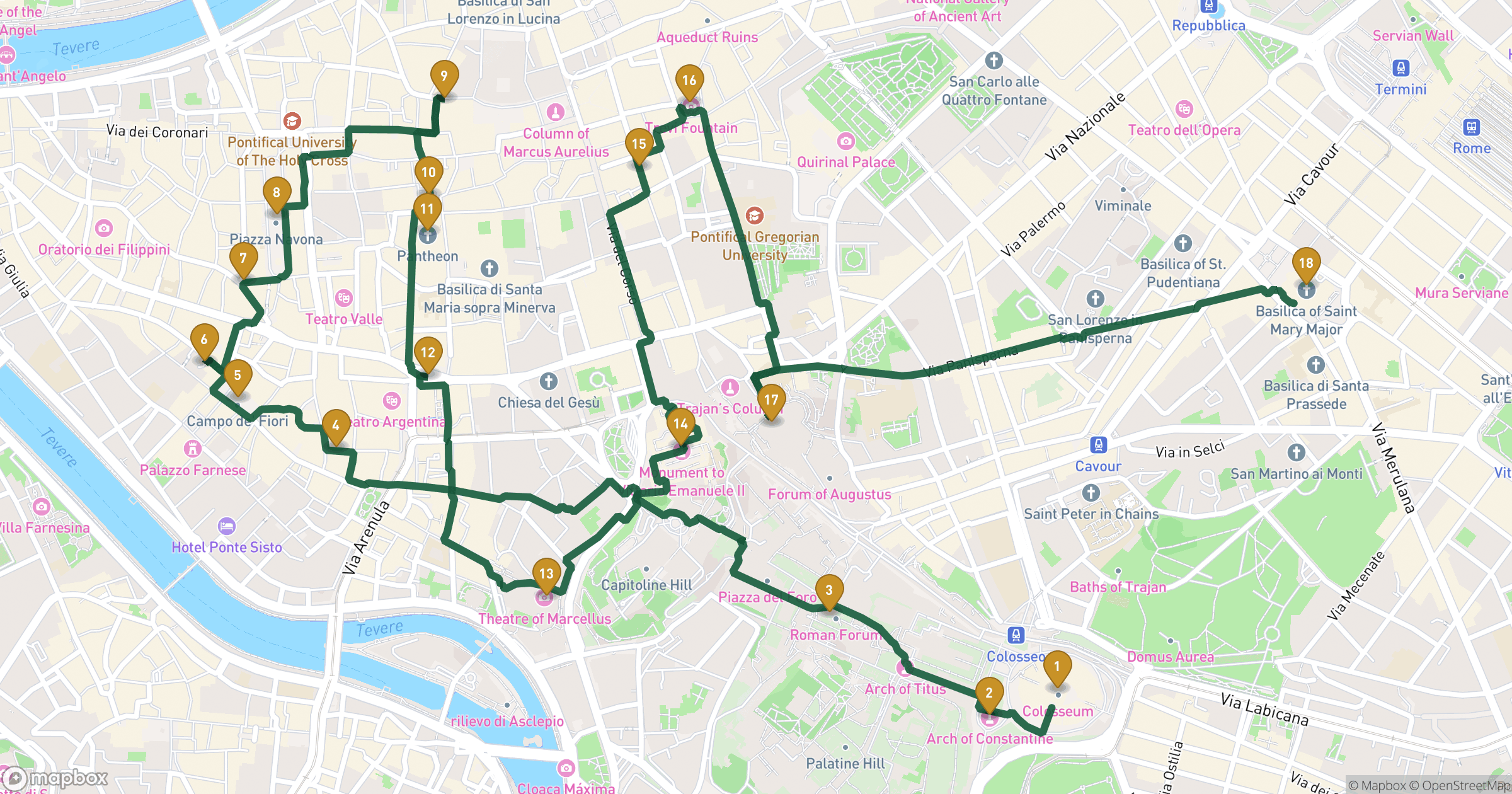
Route map for Rome walking tour

Map for Rome walking tour with 18 stops
The static map shows the tour route with Colosseo, Arco di Costantino, Roman Forum, Antico Forno Roscioli, and 14 more stops.

Stops along the route

All stops on this self-guided tour at a glance.

  1. Colosseo in Rome
    FeaturedPics / CC BY-SA 4.0

    1ColosseoAttraction

    This massive stone arena embodies Roman bread and circuses, constructed directly over Nero's drained private lake. Emperor Vespasian notably funded these soaring arches through practical measures like taxing public urinals. Today, thousands of exterior pockmarks remain visible where medieval locals dug out iron structural clamps to melt down for tools and weapons.

    Built: 82 · Style: ancient Roman architecture · Height: 48 m · Wikidata

  2. Arco di Costantino in Rome
    NikonZ7II (Paris Orlando) / CC BY-SA 4.0

    2Arco di CostantinoMonument

    This triumphal arch stands out as an ancient feat of architectural recycling, raised in 315 AD after the Battle of Milvian Bridge. Rushed builders salvaged sculpted decorations directly from monuments honoring earlier rulers like Trajan, Hadrian, and Marcus Aurelius. It marks the traditional turning point where triumphal processions pivoted directly toward the Forum.

    Named after: Constantine the Great · Wikidata

  3. Roman Forum in Rome
    Jean-Pol GRANDMONT / CC BY 4.0

    3Roman ForumAttraction

    This civic centerpiece was transformed from a marshy cemetery valley into Rome's central political and commercial gathering space. Following Julius Caesar's assassination in 44 BC, Mark Antony's funeral speech incited grieving crowds to build a makeshift funeral pyre out of market benches right in the plaza. Nearby, Vestal Virgins guarded a sacred flame inside the Temple of Vesta.

    Built: 800 BC · Wikidata

  4. 4Antico Forno RoscioliMonument

    This historic oven represents a Roman institution dedicated to perfecting pizza bianca, operating here since the early 1800s. Patriarch Marco Roscioli famously spent hours debating grain varieties with farmers to achieve his ideal crispness. A beloved local tradition involves ordering pizza e mortazza, filling warm flatbread with delicate ribbons of mortadella.

  5. Campo de' Fiori in Rome
    Carlat82 / CC BY-SA 4.0

    5Campo de' FioriSquare

    This lively public square originally started as a medieval meadow and famously remains the only major Roman piazza without a church. Dominican friar Giordano Bruno was burned at the stake here for heresy in 1600 after arguing the universe was infinite. Today, his somber bronze monument gazes directly toward the Vatican over daily stalls selling bresaola.

    Wikidata

  6. Arco degli Acetari in Rome
    Kleuske / CC BY 3.0 nl

    6Arco degli AcetariBuilding

    Hidden behind an unassuming dark archway off Via del Pellegrino, this residential courtyard preserves a distinct fourteenth-century atmosphere. Its name recalls the medieval vinegar makers who operated here, producing a crucial commodity for food preservation and cleaning. Ivy-covered walls, hanging laundry lines, and terracotta ledges define this quiet pocket today.

    Wikidata

  7. Pasquino in Rome
    Architas / CC BY-SA 4.0

    7PasquinoMonument

    This battered, armless marble fragment beside Palazzo Braschi became Rome's original public forum for anonymous political satire. Cardinal Oliviero Carafa draped it in a toga in 1501, sparking a tradition of locals affixing biting poems and complaints called pasquinades to its base. Identified as Menelaus with Patroclus, it led to a network of talking statues.

    Built: 150 · Wikidata

  8. Piazza Navona in Rome
    daryl_mitchell from Saskatoon, Saskatchewan, Canada / CC BY-SA 2.0

    8Piazza NavonaSquare

    This grand Baroque piazza preserves the exact athletic footprint of the first-century Stadium of Domitian. Gian Lorenzo Bernini anchored the center with his Fountain of the Four Rivers, crowned by an Egyptian obelisk and four monumental giants. Over the centuries, the piazza was even flooded for mock naval spectacles where aristocrats rode through the water in carriages.

    Architect: Gian Lorenzo Bernini, Francesco Borromini · Style: baroque architecture · Wikidata

  9. Giolitti in Rome
    Chino at en.wikipedia; Transferred from en.wikipedia by SreeBot / Public domain

    9GiolittiCafé

    Founded in 1890 by Giuseppe and Bernardina Giolitti, this historic parlor grew from a humble creamery into the official dairy supplier for the Italian royal family. The Art Nouveau interior retains gilded mirrors, marble floors, and staff wearing traditional waistcoats. Patrons here must navigate the classic Roman ritual of paying at the register before selecting their flavors.

    Wikidata

  10. Piazza della Rotonda in Rome
    ASaber91 / CC BY-SA 4.0

    10Piazza della RotondaSquare

    This bustling square serves as the lively forecourt to the ancient Pantheon, centered around a Renaissance fountain by Giacomo della Porta. In 1711, Pope Clement XI topped the fountain with an Egyptian obelisk carved under Ramses II for the Temple of Ra. Up through the nineteenth century, messy fish and bird vendors filled this space rather than outdoor dining tables.

    Wikidata

  11. Pantheon in Rome
    Roberta Dragan / CC BY-SA 2.5

    11PantheonChurch

    Built under Emperor Hadrian, this ancient temple features the world's largest unreinforced concrete dome, capped by a nine-meter open oculus. Rain falls straight inside onto curved flooring engineered with hidden drainage holes to clear puddles. Its interior preserves massive original bronze entry doors and holds the tomb of Renaissance master Raphael.

    Built: 128 · Architect: Apollodorus of Damascus · Style: ancient Roman architecture · Height: 43.3 m · Wikidata

  12. Area sacra dell'Argentina in Rome
    Luciano Tronati / CC BY-SA 4.0

    12Area sacra dell'ArgentinaAttraction

    Excavated in the 1920s meters below street level, these ruins preserve four Republican temples and a thriving feline sanctuary. The rear of the complex holds the remains of Pompey's Curia, the exact site where Julius Caesar was assassinated on the Ides of March in 44 BC. Around 150 protected cats live among the ancient stone columns and altars today.

    Wikidata

  13. Teatro di Marcello in Rome
    Sjaak Kempe from Groningen, The Netherlands / CC BY 2.0

    13Teatro di MarcelloAttraction

    Dedicated by Augustus in 13 BCE in memory of his nephew Marcus Claudius Marcellus, this stone theater became the design blueprint for the Colosseum. The Savelli family later hired architect Baldassare Peruzzi in the sixteenth century to construct a luxury palace directly atop the ancient tiers. Streetside silt buried the lower Doric and Ionic columns until excavations in the 1920s.

    Wikidata

  14. Altare della Patria in Rome
    Alvesgaspar / CC BY-SA 4.0

    14Altare della PatriaMonument

    Constructed from blindingly white Botticino marble, this colossal monument honors the first king of unified Italy on a reshaped hillside. Prior to its 1911 installation, engineers celebrated by hosting a seated dinner party for twenty people inside the hollow belly of the king's bronze horse. The equestrian statue is so massive that the ruler's mustache measures a full meter across.

    Built: 2000 · Architect: Giuseppe Sacconi · Style: eclectic architecture … · Height: 81 m · Wikidata

  15. Galleria Sciarra in Rome
    Labicanense / CC BY 4.0

    15Galleria SciarraBuilding

    Commissioned in the late 1880s by Prince Maffeo Barberini Colonna di Sciarra, this courtyard showcases Italy's Liberty style near the Trevi Fountain. Painter Giuseppe Cellini covered the interior in vibrant frescoes celebrating feminine virtues and scenes of daily life. The passage originally served as a covered walkway housing the editorial offices of the newspaper La Tribuna.

    Style: Art Nouveau architecture · Wikidata

  16. Fontana di Trevi in Rome
    Diliff / CC BY 3.0

    16Fontana di TreviAttraction

    Completed in 1762 by Nicola Salvi, this theatrical fountain marks the terminal point of the ancient Aqua Virgo aqueduct. Salvi deliberately sculpted a large stone vase on the eastern balustrade to block the view of a complaining local barber. The composition centers on Oceanus taming the waters with two sea horses, one calm and one agitated to reflect ocean moods.

    Built: 1732 · Architect: Giuseppe Pannini, Nicola Salvi · Style: Italian Baroque architecture · Height: 26.3 m · Wikidata

  17. Foro di Traiano in Rome
    Maksym Kozlenko / CC BY-SA 4.0

    17Foro di TraianoAttraction

    Funded by the conquest of Dacia, this expansive forum required architect Apollodorus of Damascus to excavate a ridge connecting two hills. The standing 125-foot Trajan's Column marks the exact height of the earth removed to level the ground. A spiraling relief depicts the Dacian Wars across 155 narrative scenes, featuring the emperor himself 58 times.

    Built: 100 · Named after: Trajan · Wikidata

  18. Basilica di Santa Maria Maggiore in Rome
    Pierre-Selim Huard | Self-photographed / CC BY 4.0

    18Basilica di Santa Maria MaggioreChurch

    This papal basilica preserves its original fifth-century core structure following a legendary mid-August snowfall on the Esquiline Hill. Its gilded ceiling incorporates early gold brought back from the Americas, presented as a gift by the Spanish crown. Inside, the Crypt of the Nativity contains a reliquary holding wood said to come from the Holy Crib of Jesus.

    Built: 401 · Architect: Ferdinando Fuga · Style: Renaissance architecture · Height: 75 m · Wikidata

Download the app

This public page shows a preview. The full route, all content, and navigation are available in CityTour AI.

Cities nearby

Discover self-guided tours in nearby cities.

Frequently asked questions

The key answers before you start.

Is this a self-guided audio tour?

Yes. In the CityTour AI app (iOS and Android), this is a self-guided audio tour for Rome — start anytime, at your own pace, with map, stops, and audio narration.

What will you see on this tour?

On this tour you'll see, among others, Colosseo, Arco di Costantino, Roman Forum, Antico Forno Roscioli, Campo de' Fiori, Arco degli Acetari and more sights.

Where does the tour start?

The route starts at Colosseo and ends at Basilica di Santa Maria Maggiore. You can start anytime — the app guides you to the first stop.

How long does the tour take?

About 195 minutes for 18 stops — at your own pace, with breaks whenever you like.

How much does the tour cost?

This tour costs 30 credits. The exact price depends on the pack you buy and your country — roughly $10.

Is it an outdoor tour — are entry tickets included?

Yes, it's an outdoor tour: the sights are viewed from the outside. Entry tickets are not included, and step-free access cannot be guaranteed.

Is the audio guide available in my language?

The tour and audio guide are available in English, Deutsch, Français, Español, Italiano and 9 more languages. You pick your language in the app.

Can I use the tour offline?

Yes. Tours can be used offline.

Can I ask the AI questions along the way?

Yes. At every stop you can ask the AI directly if you want to know more or didn't understand something.