


CityTour AI

Rome self-guided walking tour

Rome: From the Capitoline Hill to the Colosseum

Explore the monumental heart of Rome on a walk that weaves imperial grandeur with Renaissance and Baroque elegance. From the geometric perfection of Michelangelo's Capitoline Hill to the majesty of the Colosseum, discover how the city transformed from the center of the ancient world into a living architectural masterpiece. A journey through ancient temples and vibrant squares.

Audio tourSelf-guidediOS & Android
94minutes
3.7 kmdistance
10stops
Audio guideFormat
Rome: From the Capitoline Hill to the Colosseum
Sjaak Kempe from Groningen, The Netherlands / CC BY 2.0

Stops on this route

This tour works well for first-time visitors, weekend trips, and travelers who want to explore Rome without a fixed tour time.

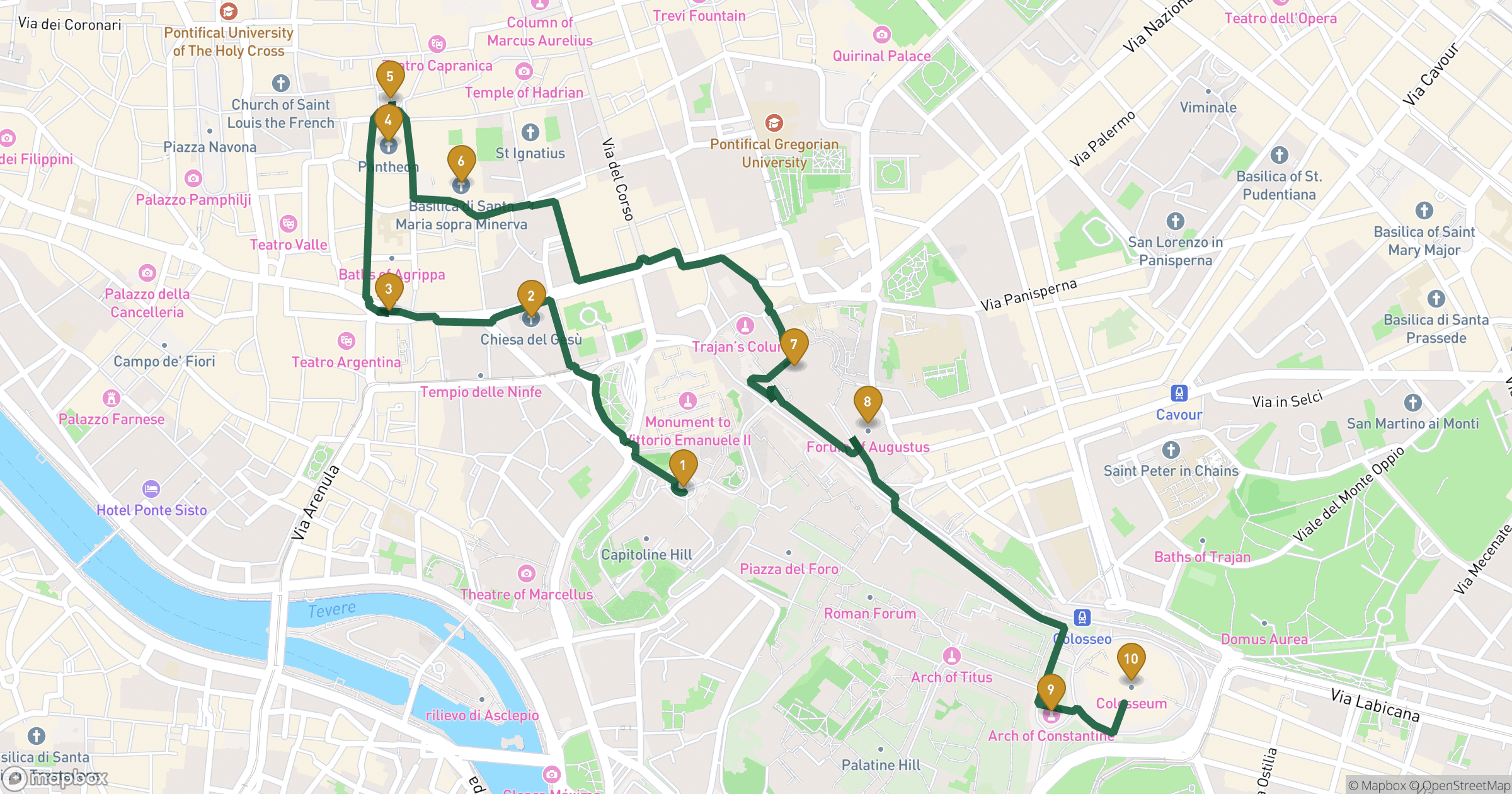
Route map for Rome walking tour

Map for Rome walking tour with 10 stops
The static map shows the tour route with Piazza del Campidoglio, Chiesa del Gesù, Area sacra dell'Argentina, Pantheon, and 6 more stops.

Stops along the route

All stops on this self-guided tour at a glance.

  1. Piazza del Campidoglio in Rome
    Kameister / CC BY-SA 4.0

    1Piazza del CampidoglioSquare

    On Capitoline Hill, the tour reveals how Michelangelo transformed an ancient sacred site into a papal showpiece. Commissioned by Pope Paul III in 1536 for Emperor Charles V's visit, he reoriented the square away from the Roman Forum toward St. Peter's Basilica. Today, an elliptical star pattern smooths the slope, centered on a replica of Marcus Aurelius's equestrian bronze.

    Architect: Michelangelo · Wikidata

  2. Chiesa del Gesù in Rome
    Rione Colonna / CC BY 4.0

    2Chiesa del GesùChurch

    The Church of the Gesù stands as the Jesuit mother church and the architectural model of the Counter-Reformation. Inside, Giovanni Battista Gaulli painted shadows over stucco frames to make figures appear to tumble from the heavens into the nave. Outside, Cardinal Alessandro Farnese insisted on having his name inscribed in massive letters right over the main portal.

    Built: 1568 · Architect: Giacomo Barozzi da Vignola, Giacomo della Porta … · Style: Jesuit architecture … · Wikidata

  3. Area sacra dell'Argentina in Rome
    Luciano Tronati / CC BY-SA 4.0

    3Area sacra dell'ArgentinaAttraction

    Largo di Torre Argentina preserves four Republican temples designated simply A, B, C, and D since their 1920s excavation. Behind these temples stood Pompey's Curia, where Julius Caesar was assassinated with 23 stab wounds on the Ides of March in 44 BC. Today, a protected feline colony roams the ruins where decisions once shaped the fate of the Roman Republic.

    Wikidata

  4. Pantheon in Rome
    Roberta Dragan / CC BY-SA 2.5

    4PantheonChurch

    The tour approaches the Pantheon, highlighting how Emperor Hadrian preserved Marcus Agrippa's original dedicatory inscription on the frieze. Its unreinforced concrete dome spans an interior sphere where the diameter precisely matches the building's height. Rain entering through the nine-meter central oculus drains through 22 subtle holes in the convex marble floor.

    Built: 128 · Architect: Apollodorus of Damascus · Style: ancient Roman architecture · Height: 43.3 m · Wikidata

  5. Piazza della Rotonda in Rome
    Sjaak Kempe from Groningen, The Netherlands / CC BY 2.0

    5Piazza della RotondaSquare

    Piazza della Rotonda centers on a Renaissance fountain topped by a red granite Egyptian obelisk from the reign of Ramesses II. Moved here by Pope Clement XI in 1711, the monument rests on a base carved with dolphins and papal coats of arms. Centuries of Tiber flood silt have elevated the square, leaving the neighboring Pantheon visibly sunken below modern ground level.

    Wikidata

  6. Basilica di Santa Maria sopra Minerva in Rome
    Merulana / CC BY-SA 4.0

    6Basilica di Santa Maria sopra MinervaChurch

    Behind the Pantheon, Santa Maria sopra Minerva features an unusual blue vaulted ceiling dotted with gold stars. Commissioned nearby, Michelangelo's 1521 statue of the Risen Christ sits inside this former site of an Isis temple. Outside, Bernini angled a marble elephant carrying an obelisk so its rear faced the Dominican convent following disputes with the friars.

    Built: 1370 · Architect: Carlo Maderno · Style: Gothic architecture · Named after: Mary · Wikidata

  7. Foro di Traiano in Rome
    Jakub Hałun / CC BY-SA 4.0

    7Foro di TraianoAttraction

    Trajan's Forum was built with spoils from the Dacian Wars after excavating an entire hillside between the Quirinal and Capitoline. The 30-meter Trajan's Column features a continuous spiral relief depicting military actions, bridge construction, and Trajan addressing troops. Adjacent semicircular markets by Apollodorus of Damascus doubled as buttresses to shore up the excavated hill.

    Built: 100 · Named after: Trajan · Wikidata

  8. Foro di Augusto in Rome
    Marek Mróz / CC BY 4.0

    8Foro di AugustoAttraction

    The Forum of Augustus centers on the Temple of Mars Ultor, built to honor a vow made before defeating Caesar's assassins at Philippi. Three colossal Corinthian columns remain standing against a massive 33-meter-high peperino stone wall. This imposing barrier protected the forum from fires in the Suburra neighborhood while walling off the slums from the legal center.

    Wikidata

  9. Arco di Costantino in Rome
    NikonZ7II (Paris Orlando) / CC BY-SA 4.0

    9Arco di CostantinoMonument

    Erected in 315 AD near the Colosseum, the Arch of Constantine commemorates the emperor's victory over Maxentius at the Milvian Bridge. The structure incorporates salvaged reliefs and Dacian prisoner statues taken directly from earlier monuments of Trajan, Hadrian, and Marcus Aurelius. Its dedicatory text avoids overt Christian imagery, crediting victory to divine inspiration.

    Named after: Constantine the Great · Wikidata

  10. Colosseo in Rome
    FeaturedPics / CC BY-SA 4.0

    10ColosseoAttraction

    The Colosseum accommodated up to 80,000 spectators across 80 numbered entrance arches beneath a giant awning rigged by imperial sailors. Thousands of exterior holes visible today mark where medieval foragers extracted iron and lead clamps from the travertine blocks. Beneath the arena floor, the exposed hypogeum operated manual lifts to hoist gladiators and animals.

    Built: 82 · Style: ancient Roman architecture · Height: 48 m · Wikidata

Download the app

This public page shows a preview. The full route, all content, and navigation are available in CityTour AI.

Cities nearby

Discover self-guided tours in nearby cities.

Frequently asked questions

The key answers before you start.

Is this a self-guided audio tour?

Yes. In the CityTour AI app (iOS and Android), this is a self-guided audio tour for Rome — start anytime, at your own pace, with map, stops, and audio narration.

What will you see on this tour?

On this tour you'll see, among others, Piazza del Campidoglio, Chiesa del Gesù, Area sacra dell'Argentina, Pantheon, Piazza della Rotonda, Basilica di Santa Maria sopra Minerva and more sights.

Where does the tour start?

The route starts at Piazza del Campidoglio and ends at Colosseo. You can start anytime — the app guides you to the first stop.

How long does the tour take?

About 94 minutes for 10 stops — at your own pace, with breaks whenever you like.

How much does the tour cost?

This tour costs 15 credits. The exact price depends on the pack you buy and your country — roughly $5.

Is it an outdoor tour — are entry tickets included?

Yes, it's an outdoor tour: the sights are viewed from the outside. Entry tickets are not included, and step-free access cannot be guaranteed.

Is the audio guide available in my language?

The tour and audio guide are available in English, Deutsch, Français, Español, Italiano and 9 more languages. You pick your language in the app.

Can I use the tour offline?

Yes. Tours can be used offline.

Can I ask the AI questions along the way?

Yes. At every stop you can ask the AI directly if you want to know more or didn't understand something.