CityTour AI

London self-guided walking tour

A King's Promenade: Gothic Spires and Hidden Soho Secrets

Join a most regal promenade through the heart of Our capital, where the grandest Gothic spires meet the narrowest hidden alleys. From the seat of Our government to the secret studios where the Beatles made history, this tour reveals the architectural whims and curious legends of London. Experience the city through the eyes of an 18th-century monarch who finds modern marvels and ancient stones equally delightful.


Audio tourSelf-guidediOS & Android
178minutes
7.4 kmdistance
17stops
Audio guideFormat
A King's Promenade: Gothic Spires and Hidden Soho Secrets
Terry Ott from Washington, DC Metro Area, United States of America / CC BY 2.0

Stops on this route

This tour works well for first-time visitors, weekend trips, and travelers who want to explore London without a fixed tour time.
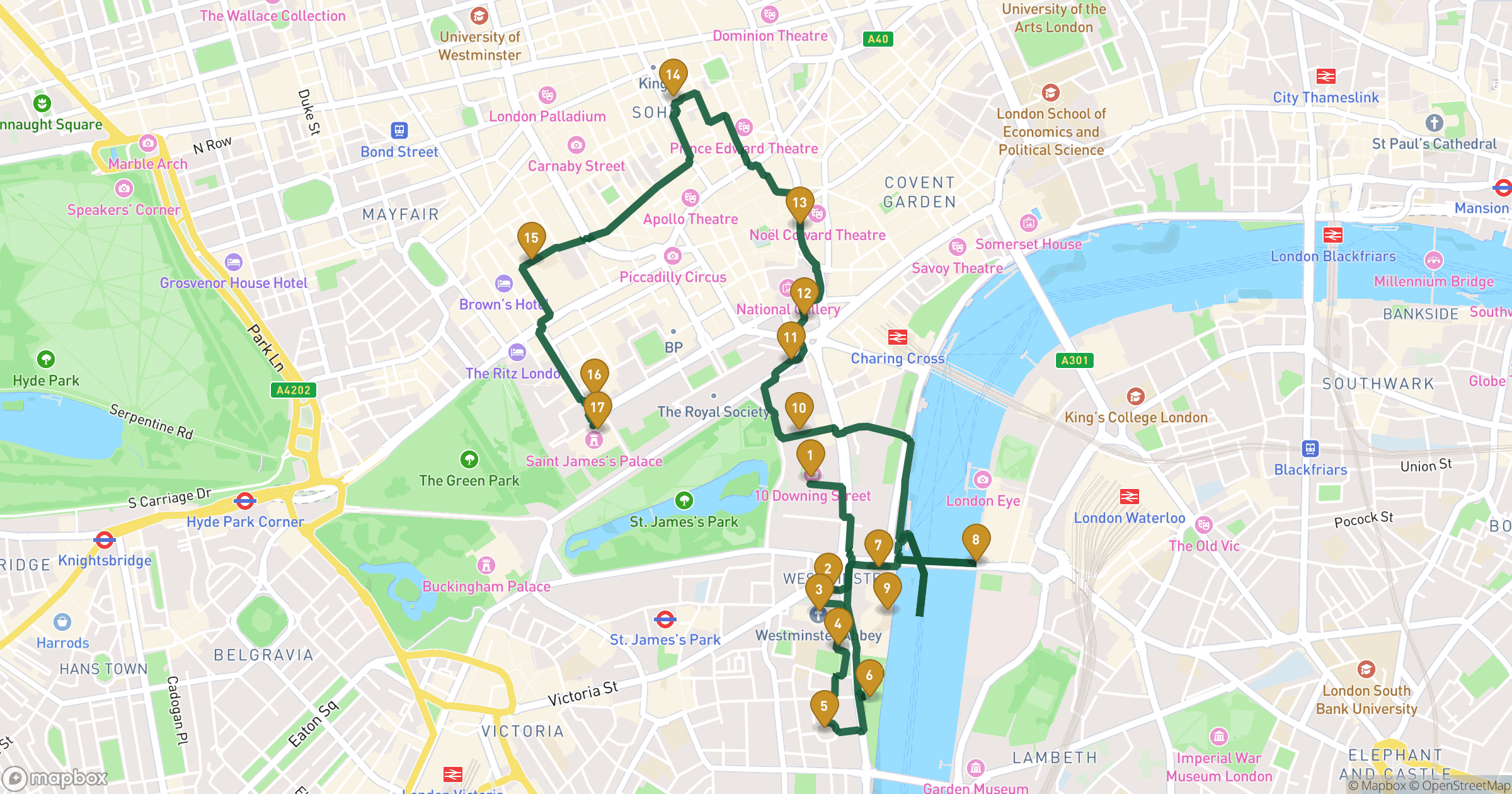
Route map for London walking tour

Map for London walking tour with 17 stops
The static map shows the tour route with 10 Downing Street, St Margaret's Church, Westminster Abbey, Jewel Tower, and 13 more stops.

Stops along the route

All stops on this self-guided tour at a glance.

  1. 10 Downing Street in London
    Richard Symonds / CC BY 3.0

    110 Downing StreetAttraction

    Number 10 Downing Street is the modest terraced residence of the Prime Minister, gifted by King George II in 1732 to the office itself. Although the entrance resembles simple wood, it is actually blast-proof steel fitted after an incident in 1991, featuring a noticeably tilted zero in the numeral ten. The exterior bricks were originally yellow, but were painted black in the 1960s to maintain their coal-darkened look.

    Built: 1684 · Architect: Kenton Couse, William Kent · Style: Georgian architecture … · Wikidata

  2. St Margaret's Church in London
    Canaletto / Public domain

    2St Margaret's Church

    St Margaret's Church sits beside the great abbey, serving as the official parish house for the House of Commons. Sir Walter Raleigh lies buried beneath the altar following his execution in nearby Old Palace Yard in 1618. The interior features a Flemish glass east window originally intended for the marriage of Arthur Tudor and Catherine of Aragon.

    Built: 1050 · Style: Perpendicular Gothic · Wikidata

  3. Westminster Abbey in London
    Σπάρτακος / CC BY-SA 3.0

    3Westminster AbbeyChurch

    Westminster Abbey has served as the coronation site for nearly every English monarch since 1066. The historic Coronation Chair inside still bears graffiti carved into the wood by eighteenth-century schoolboys. Outside, Nicholas Hawksmoor completed the soaring West Front towers in the 1740s, closely echoing the thirteenth-century Gothic style.

    Built: 901 · Style: Gothic architecture … · Named after: Saint Peter · Wikidata

  4. Jewel Tower in London
    No machine-readable author provided. Lonpicman~commonswiki assumed (based on copyright claims). / CC BY-SA 3.0

    4Jewel Tower

    The Jewel Tower is an enduring medieval survivor of the Palace of Westminster, commissioned in 1365 by Edward III as his secure Privy Wardrobe. Built with thick ragstone walls and surrounded by its own protective moat, it later stored parliamentary records for nearly three centuries. Medieval stonemasons' marks remain visible directly on the masonry today.

    Built: 1366 · Architect: Henry Yevele · Wikidata

  5. St John's, Smith Square in London
    Prioryman / CC BY-SA 4.0

    5St John's, Smith SquareTheatre

    St John's, Smith Square is an English Baroque church completed in 1728, known as the Upturned Footstool after Queen Anne purportedly kicked over furniture to demonstrate her desired design. The prominent four corner towers were engineered specifically to anchor the heavy structure in the marshy soil of Millbank. Gutted during the Blitz in 1941, the building now functions as an acoustic concert hall.

    Built: 1713 · Architect: Thomas Archer · Style: English Baroque · Wikidata

  6. Victoria Tower Gardens in London
    Editor5807 / CC BY 3.0

    6Victoria Tower GardensPark

    Victoria Tower Gardens provides an open riverside retreat beside Parliament, created in the 1870s to buffer the palace from surrounding slums. The park features the ornate Buxton Memorial Fountain, erected in 1865 to commemorate the abolition of slavery across the British Empire. Auguste Rodin's nearby bronze sculpture depicts the six Burghers of Calais from the Hundred Years' War.

    Built: 1870 · Wikidata

  7. Big Ben in London
    Castfam13 / CC BY 4.0

    7Big BenTower

    The Elizabeth Tower houses the iconic thirteen-ton bell properly known as Big Ben. Augustus Pugin designed the intricate Gothic Revival tower, whose pendulum was famously regulated for precision using a stack of pennies. Above the four opal-glass clock faces, a special lantern illuminates whenever Parliament is actively sitting.

    Built: 1843 · Architect: Charles Barry, Augustus Pugin · Style: Gothic Revival · Height: 96 m · Wikidata

  8. Westminster Bridge in London
    Berit from Redhill/Surrey, UK / CC BY 2.0

    8Westminster BridgeBuilding

    Westminster Bridge, completed in 1862, is the oldest surviving road bridge in central London. Its distinctive green color scheme deliberately matches the leather seating benches within the House of Commons. Beneath the Gothic ironwork, heavy granite piers anchor the crossing firmly against the tidal Thames.

    Architect: Thomas Page · Named after: Westminster · Wikidata

  9. Palace of Westminster in London
    Terry Ott from Washington, DC Metro Area, United States of America / CC BY 2.0

    9Palace of WestminsterCastle

    The Palace of Westminster was designed in Gothic Revival style by Charles Barry and Augustus Pugin after a catastrophic fire in 1834. Pugin personally designed everything down to the inkwells and costly wallpaper across its eleven courtyards and thousand rooms. The nineteenth-century building incorporated an innovative early air-conditioning system that drew fresh currents down through its towers.

    Architect: Charles Barry, Jr., Augustus Pugin · Style: Perpendicular Gothic … · Wikidata

  10. Horse Guards Parade in London
    Lcw27, Lucia Constance Wallbank / CC BY-SA 3.0

    10Horse Guards ParadeAttraction

    Horse Guards Parade showcases classical Palladian military architecture designed by William Kent in the mid-eighteenth century. The central clock tower features a distinct black mark at two o'clock, recalling the exact hour King Charles I was beheaded nearby in 1649. Every day, the King's Life Guard rides here from Hyde Park Barracks to continue a mounting tradition dating back to 1660.

    Wikidata

  11. Admiralty Arch in London
    Philip Pankhurst / CC BY-SA 2.0

    11Admiralty ArchBuilding

    Admiralty Arch is an Edwardian ceremonial gate completed in 1912 by Sir Aston Webb to honor Queen Victoria. The central gateway of the three arches is reserved strictly for use by the reigning Sovereign. A small brass nose remains mounted onto one of the archways, celebrated by local lore as a tribute to the Duke of Wellington.

    Built: 1911 · Architect: Aston Webb · Style: Neoclassical architecture · Wikidata

  12. Trafalgar Square in London
    Diliff / CC BY-SA 3.0

    12Trafalgar Square

    Trafalgar Square marks the center of London, established to commemorate Admiral Nelson's decisive naval triumph in 1805. Surrounding the towering column, Sir Edwin Landseer sculpted four bronze lions based on a deceased specimen obtained from the London Zoo. The southeast corner conceals what was once the world's smallest police box, hollowed out inside an ornamental stone lamp post in the 1920s.

    Built: 1840 · Named after: Battle of Trafalgar · Wikidata

  13. Cecil Court in London
    Jack1956 at English Wikipedia / Public domain

    13Cecil CourtSquare

    Cecil Court is a preserved Victorian lane celebrated as Booksellers' Row, where antique shops and traditional hanging signs still line the pavement. A young Wolfgang Amadeus Mozart resided here as an eight-year-old child prodigy during his European tour in 1764. In modern times, the charming thoroughfare served as an aesthetic template for the fictional Diagon Alley.

    Wikidata

  14. Trident Studios in London
    AbstractLakx / CC BY-SA 4.0

    14Trident Studios

    Trident Studios was a discreet Soho recording suite that pioneered early modern sound technology. The Beatles recorded their hit Hey Jude here in 1968 to take advantage of the studio's superior eight-track tape machines. Artists such as David Bowie and Elton John also recorded tracks within this unpretentious alley building.

    Built: 1968 · Wikidata

  15. Burlington Arcade in London
    Andrew Dunn / CC BY-SA 2.0

    15Burlington ArcadeAttraction

    Burlington Arcade was built in 1819 by Lord George Cavendish, commissioned in part to stop pedestrians from flinging discarded oyster shells into his garden. It is continuously patrolled by the Beadles, the world's smallest private police force, wearing top hats and frock coats. These guards enforce strict historic bylaws prohibiting running, carrying large parcels, or whistling.

    Built: 1819 · Architect: Samuel Ware, Arthur Beresford Pite · Style: Art Nouveau architecture … · Wikidata

  16. Pickering Place in London
    Matt Brown / CC BY 2.0

    16Pickering PlaceSquare

    Pickering Place is London's smallest public square, renowned for hosting the capital's final duel fought with pistols. Between 1842 and 1845, the Republic of Texas maintained its diplomatic legation above a wine merchant here before joining the United States. An outstanding rent balance from the legation's departure was settled more than a century later in the 1980s with a delivery of pecans.

    Wikidata

  17. Saint James's Palace in London
    siegertmarc / CC BY 2.0

    17Saint James's PalaceCastle

    St James's Palace was built by Henry VIII in the 1530s atop the grounds of an old leper hospital, remaining the formal seat of the Royal Court. Queen Elizabeth I lodged within its distinctive diaper-patterned Tudor brick walls while waiting out the arrival of the Spanish Armada. Today, foreign ambassadors to the United Kingdom are still formally accredited to this court.

    Built: 1533 · Architect: Christopher Wren · Style: Brick Gothic … · Named after: St. James the Elder · Wikidata

Download the app

This public page shows a preview. The full route, all content, and navigation are available in CityTour AI.

Cities nearby

Discover self-guided tours in nearby cities.

Frequently asked questions

The key answers before you start.

Is this a self-guided audio tour?

Yes. In the CityTour AI app (iOS and Android), this is a self-guided audio tour for London — start anytime, at your own pace, with map, stops, and audio narration.

What will you see on this tour?

On this tour you'll see, among others, 10 Downing Street, St Margaret's Church, Westminster Abbey, Jewel Tower, St John's, Smith Square, Victoria Tower Gardens and more sights.

Where does the tour start?

The route starts at 10 Downing Street and ends at Saint James's Palace. You can start anytime — the app guides you to the first stop.

How long does the tour take?

About 178 minutes for 17 stops — at your own pace, with breaks whenever you like.

How much does the tour cost?

This tour costs 30 credits. The exact price depends on the pack you buy and your country — roughly $10.

Is it an outdoor tour — are entry tickets included?

Yes, it's an outdoor tour: the sights are viewed from the outside. Entry tickets are not included, and step-free access cannot be guaranteed.

Is the audio guide available in my language?

The tour and audio guide are available in English, Deutsch, Français, Español, Italiano and 9 more languages. You pick your language in the app.

Can I use the tour offline?

Yes. Tours can be used offline.

Can I ask the AI questions along the way?

Yes. At every stop you can ask the AI directly if you want to know more or didn't understand something.