CityTour AI

London self-guided walking tour

Marylebone & Paddington: Village Charm and Design Wonders

Experience the fascinating contrast between elegant Marylebone and the futuristic Paddington Basin. This relaxed walk takes you from the literary traces of Baker Street through green park oases to modern architectural masterpieces. Discover the authentic London lifestyle in hidden alleys and historic sites away from the main tourist crowds.

Audio tourSelf-guidediOS & Android
192minutes
7.9 kmdistance
18stops
Audio guideFormat
Marylebone & Paddington: Village Charm and Design Wonders
Oliver Dixon / CC BY-SA 2.0

Stops on this route

This tour works well for first-time visitors, weekend trips, and travelers who want to explore London without a fixed tour time.
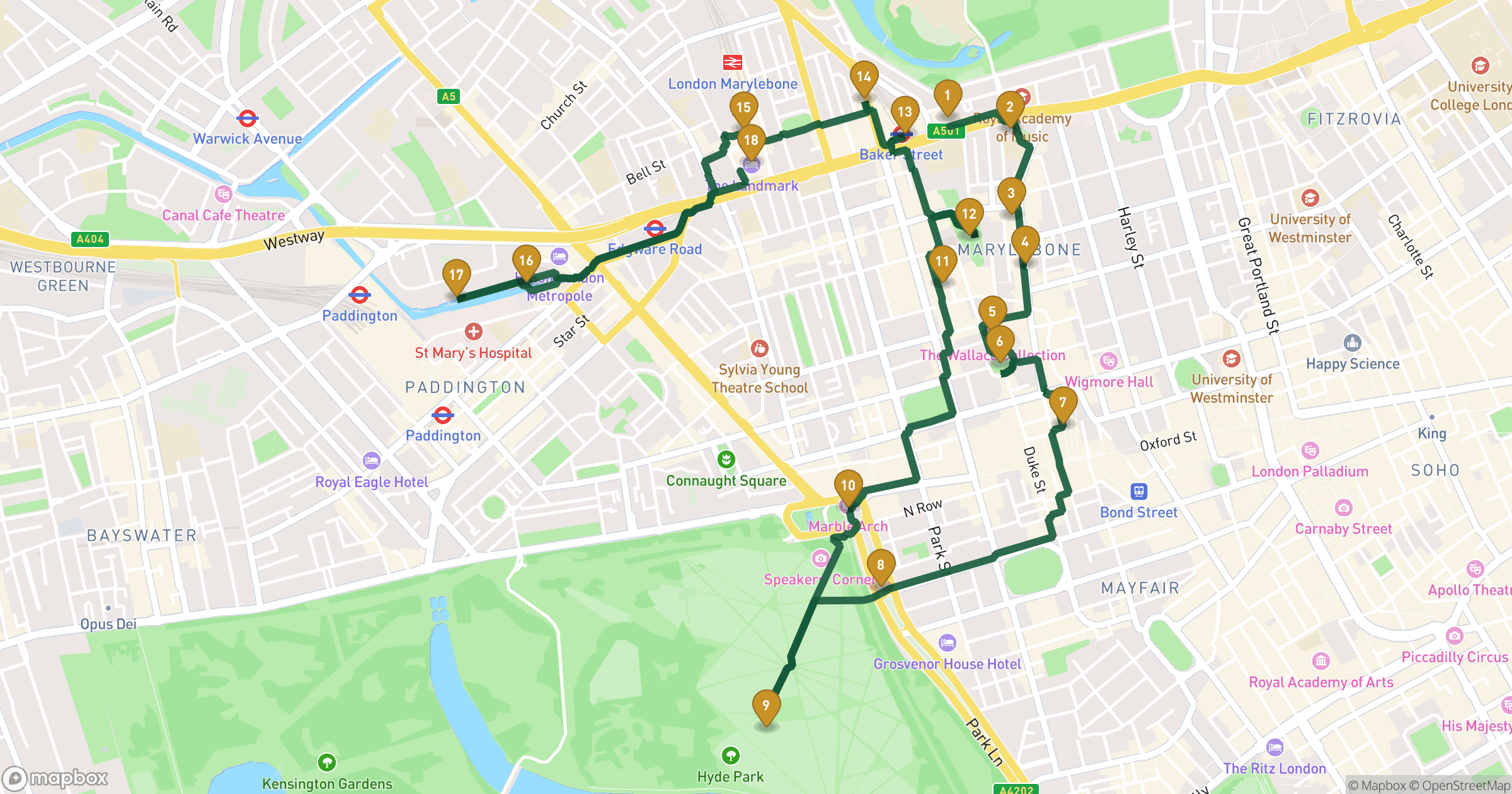
Route map for London walking tour

Map for London walking tour with 18 stops
The static map shows the tour route with Madame Tussauds, St Marylebone Parish Church, Marylebone, Daunt Books Marylebone, Marylebone High Street, and 14 more stops.

Stops along the route

All stops on this self-guided tour at a glance.

  1. Madame Tussauds in London
    I, Citizen59; Citizen59 / CC BY-SA 3.0

    1Madame TussaudsMuseum

    Madame Tussauds is traced back here to Marie Tussaud, who learned wax modeling in Bern and Paris before surviving the French Revolution. Forced to create death masks beneath the guillotine, including those of King Louis XVI and Marie Antoinette, she brought these originals to Britain in 1802. A 1925 fire melted many figures, but the basement molds preserved the collection.

    Built: 1839 · Named after: Marie Tussaud · Wikidata

  2. St Marylebone Parish Church, Marylebone in London
    Church of St Marylebone by N Chadwick; N Chadwick; Geograph Britain and Ireland / CC BY-SA 2.0

    2St Marylebone Parish Church, Marylebone

    St Marylebone Parish Church gave the entire neighborhood its name, which derives from a previous church along the Tyburn stream. Designed by Thomas Hardwick and completed in 1817, its Roman-inspired tower features eight caryatid figures serving as columns. In 1846, poets Elizabeth Barrett and Robert Browning held their famous secret wedding ceremony here without her father knowing.

    Built: 1813 · Architect: Thomas Hardwick · Wikidata

  3. Daunt Books Marylebone in London
    RachelH_ / CC BY 2.0

    3Daunt Books Marylebone

    Daunt Books stands out as a pioneering, purpose-built bookshop set within an elegant Edwardian interior. Built originally in 1910 for Francis Edwards, the shop organizes its inventory not by genre, but strictly by country. Oak galleries and soaring skylights frame a space where travel guides, history, and fiction from the same geographical region sit side by side on shelves.

    Wikidata

  4. Marylebone High Street in London
    Philafrenzy / CC BY-SA 4.0

    4Marylebone High Street

    Marylebone High Street showcases the enduring, independent character of an ancient village swallowed by urban expansion in the 18th century. The curving line of the road still directly follows the historic path of the subterranean Tyburn River. Broad sidewalks lined with Georgian and Victorian facades host specialized delicatessens, family-run boutiques, and welcoming cafes.

  5. Wallace Collection in London
    Peter Clarke / CC BY-SA 3.0

    5Wallace CollectionMuseum

    Hertford House holds the Wallace Collection, an extraordinary private art assembly preserved inside a domestic residence. Sir Richard Wallace, who previously funded the iconic public drinking fountains in Paris during the 1870 siege, was the illegitimate son of the 4th Marquess. Lady Wallace bequeathed the entire estate under the strict condition that it remain together as one unit.

    Built: 1900 · Named after: Sir Richard Wallace, 1st Baronet · Wikidata

  6. Manchester Square in London
    Magnus Manske / CC BY-SA 3.0

    6Manchester SquarePark

    Manchester Square preserves a refined late 18th-century Georgian layout conceived in 1776 around the Duke of Manchester's estate. Local lore claims the Duke chose the unbuilt area because it offered prime territory for hunting ducks. In 1963, The Beatles stood on the stairwell of the former EMI Records headquarters on the corner to shoot their 'Please Please Me' album cover.

    Wikidata

  7. St Christopher's Place in London
    Anthony O'Neil / CC BY-SA 2.0

    7St Christopher's PlaceSquare

    St Christopher's Place hides behind an exceptionally narrow alleyway branching straight off busy Oxford Street. Formerly known as Barrett's Court, the area was considered run-down until it underwent a dedicated restoration in the 1960s. Today the pedestrian zone features bright facade colors, hanging flower baskets, open-air terraces, and boutique shops reminiscent of an Italian village.

    Wikidata

  8. Animals in War Memorial in London
    Ryan Hodnett / CC BY-SA 4.0

    8Animals in War Memorial

    The Animals in War Memorial stands along Park Lane to commemorate the animals that served and died alongside humans in 20th-century conflicts. Sculptor David Backhouse depicted two burdened bronze mules struggling through a gap in a massive stone wall toward a waiting dog and horse. The carving notes their lack of choice, honoring creatures ranging from carrier pigeons to glowworms.

    Built: 2004 · Wikidata

  9. Hyde Park in London
    Mario Sánchez Prada / CC BY-SA 2.0

    9Hyde Park

    Hyde Park serves as a sprawling historic royal ground originally established by King Henry VIII as a private hunting territory. Queen Caroline commissioned the central, artificial Serpentine Lake in the 18th century. Since 1872, the northeast corner has hosted Speakers' Corner, where anyone may address the crowd on nearly any topic so long as it spares the royal family.

    Wikidata

  10. Marble Arch in London
    Katie Chan / CC BY-SA 3.0

    10Marble ArchAttraction

    Marble Arch was designed in 1828 by John Nash using white Carrara marble, drawing direct inspiration from Rome's Arch of Constantine. Originally installed as the grand entrance to Buckingham Palace, it was relocated in 1851 after a new palace wing displaced it. Detailed reliefs represent England, Scotland, and Ireland, not far from the historic site of the Tyburn gallows.

    Built: 1828 · Architect: John Nash · Named after: Carrara marble · Wikidata

  11. Chiltern Firehouse in London
    J c / CC BY 2.0

    11Chiltern Firehouse

    Chiltern Firehouse occupies the 1889 Manchester Square Fire Station, built by Robert Pearsall in a decorative Tudor-Gothic style. Large red-brick carriage doors, once used by horse-drawn emergency engines, remain in place as the entrance to André Balazs's converted luxury establishment. Following decades of service, the station closed in 2005 and endured another fire in 2025.

    Built: 1889 · Wikidata

  12. Paddington Street Gardens in London
    Ewan Munro from London, UK; Paddington Street Gardens, City of Westminster, W1 Uploaded by Oxyman / CC BY-SA 2.0

    12Paddington Street GardensPark

    Paddington Street Gardens occupies land established in 1730 by Edward Harley to serve as an overflow parish graveyard. Fanny Wilkinson, Britain's first professional female landscape gardener, transformed the burial ground containing an estimated 80,000 to 110,000 bodies into an 1885 public park. An ornamental mausoleum from 1759 built by Richard Fitzpatrick still stands on site.

    Wikidata

  13. Statue of Sherlock Holmes in London
    Photograph by Mike Peel (www.mikepeel.net). / CC BY-SA 4.0

    13Statue of Sherlock HolmesMonument

    Sherlock Holmes stands outside Baker Street Underground station as a three-meter-tall bronze tribute created by sculptor John Doubleday. Unveiled in 1999, the statue depicts the fictional detective in his deerstalker hat and textured coat, clutching a pipe. The monument was funded by Abbey National, the building society located at the detective's fictional home territory.

    Built: 1999 · Wikidata

  14. 221B Baker Street in London
    221b, Baker St by N Chadwick; N Chadwick; Geograph Britain and Ireland / CC BY-SA 2.0

    14221B Baker StreetAttraction

    Baker Street 221B addresses a celebrated fictional residence that lay beyond the real street numbers when Arthur Conan Doyle created it. Abbey National later occupied numbers 219 to 229, employing a secretary to reply that Holmes had retired to Sussex to keep bees. Across from the museum door, an empty house recalls the perch used to thwart an assassin in Doyle's short stories.

    Wikidata

  15. Marylebone station in London
    Rept0n1x / CC BY-SA 3.0

    15Marylebone station

    Marylebone Station opened in 1899 as the compact red-brick terminal of the Great Central Railway, designed by Henry William Braddock. Financial shortages reduced the original ten-platform blueprint to a modest layout with a spacious, sunlit glass canopy overhead. The Beatles ran across these platforms in 1964 while filming opening chase sequences for 'A Hard Day's Night'.

    Style: Edwardian architecture · Wikidata

  16. Merchant Square Footbridge in London
    -JvL- / CC BY 2.0

    16Merchant Square Footbridge

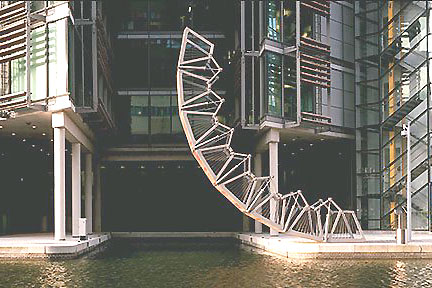
    The Merchant Square Footbridge spans Paddington Basin as a kinetic sculptural crossing created by Knight Architects. Rather than opening with a traditional lift, five massive steel beams raise sequentially at varying angles to resemble a traditional Japanese folding fan. Typically operating at midday on Fridays, hydraulic mechanisms silently hoist the heavy components skyward.

    Wikidata

  17. The Rolling Bridge in London
    en:User:Leonard G. / CC BY-SA 3.0

    17The Rolling Bridge

    The Rolling Bridge provides an unusual canal crossing conceived by British designer Thomas Heatherwick and completed in 2004. Instead of elevating on standard hinges, the hybrid steel-and-timber structure curls backward into a compact octagonal shape beside the water. When needed, the eight interlocked segments steadily unfurl across the canal surface to let pedestrians cross.

    Built: 2004 · Architect: Thomas Heatherwick · Wikidata

  18. The Landmark London in London
    ชีวิตไมสิ้น ก็ดิ้นกันไป / CC0

    18The Landmark London

    The Landmark London opened in 1899 as the Hotel Great Central, built by Robert William Edis with yellow brick and a clock tower. Backer Sir Edward Watkin envisioned Marylebone connecting rail passengers directly through a tunnel to France after his attempt to copy the Eiffel Tower failed. Its carriage entrance was later transformed into an indoor courtyard garden beneath a glass roof.

    Built: 1899 · Architect: Robert William Edis · Wikidata

Download the app

This public page shows a preview. The full route, all content, and navigation are available in CityTour AI.

Cities nearby

Discover self-guided tours in nearby cities.

Frequently asked questions

The key answers before you start.

Is this a self-guided audio tour?

Yes. In the CityTour AI app (iOS and Android), this is a self-guided audio tour for London — start anytime, at your own pace, with map, stops, and audio narration.

What will you see on this tour?

On this tour you'll see, among others, Madame Tussauds, St Marylebone Parish Church, Marylebone, Daunt Books Marylebone, Marylebone High Street, Wallace Collection, Manchester Square and more sights.

Where does the tour start?

The route starts at Madame Tussauds and ends at The Landmark London. You can start anytime — the app guides you to the first stop.

How long does the tour take?

About 192 minutes for 18 stops — at your own pace, with breaks whenever you like.

How much does the tour cost?

This tour costs 30 credits. The exact price depends on the pack you buy and your country — roughly $10.

Is it an outdoor tour — are entry tickets included?

Yes, it's an outdoor tour: the sights are viewed from the outside. Entry tickets are not included, and step-free access cannot be guaranteed.

Is the audio guide available in my language?

The tour and audio guide are available in English, Deutsch, Français, Español, Italiano and 9 more languages. You pick your language in the app.

Can I use the tour offline?

Yes. Tours can be used offline.

Can I ask the AI questions along the way?

Yes. At every stop you can ask the AI directly if you want to know more or didn't understand something.