CityTour AI

London self-guided walking tour

London’s Grand Facades: From Royal Courts to Riverside Icons

Stroll through the heart of London to discover how royal ambition and Victorian engineering shaped the city's most famous skyline. From the medieval secrets of the Knights Templar to the bold concrete of Brutalist masterpieces, this walk reveals the stories hidden behind the grand stone facades. You will see iconic landmarks like the Palace of Westminster and Buckingham Palace through the eyes of the architects and rebels who built them.

Audio tourSelf-guidediOS & Android
180minutes
6.0 kmdistance
19stops
Audio guideFormat
London’s Grand Facades: From Royal Courts to Riverside Icons
Diliff / CC BY-SA 3.0

Stops on this route

This tour works well for first-time visitors, weekend trips, and travelers who want to explore London without a fixed tour time.

Route map for London walking tour

Map for London walking tour with 19 stops
The static map shows the tour route with Trafalgar Square, Admiralty Arch, Horse Guards Parade, Banqueting House, and 15 more stops.

Stops along the route

All stops on this self-guided tour at a glance.

  1. Trafalgar Square in London
    Diliff / CC BY-SA 3.0

    1Trafalgar Square

    Trafalgar Square marks the geographic center of London and showcases Sir Charles Barry's 1840s urban layout. Nelson's Column commemorates the 1805 naval victory over French and Spanish fleets, supported by bronze lions modeled partly on dog paws after a study carcass rotted. Today, a rotating modern art exhibit on the fourth plinth contrasts with the square's permanent Victorian statues.

    Built: 1840 · Named after: Battle of Trafalgar · Wikidata

  2. Admiralty Arch in London
    Philip Pankhurst / CC BY-SA 2.0

    2Admiralty ArchBuilding

    Admiralty Arch serves as the ceremonial entrance to The Mall, commissioned by King Edward VII in memory of Queen Victoria. Completed in 1912 by Sir Aston Webb, the Edwardian Baroque structure features a curved design intentionally aligned to frame the distant Victoria Memorial. Though long used as government offices for the First Sea Lord, its central passage is reserved solely for royal processions.

    Built: 1911 · Architect: Aston Webb · Style: Neoclassical architecture · Wikidata

  3. Horse Guards Parade in London
    Lcw27, Lucia Constance Wallbank / CC BY-SA 3.0

    3Horse Guards ParadeAttraction

    Horse Guards Parade has hosted royal ceremonies since the seventeenth century, framed by Palladian buildings designed by William Kent. Mounted sentries from the Household Cavalry guard the gates, upholding a tradition started in 1660 under Charles II. Above the central arch, the clock tower bears a black mark at the two o'clock position to note the hour King Charles I was executed.

    Wikidata

  4. Banqueting House in London
    VirtuallyLondonBecky / CC BY-SA 4.0

    4Banqueting HouseAttraction

    Banqueting House is the sole surviving section of the Palace of Whitehall, which burned down in 1698. Architect Inigo Jones drew inspiration from Andrea Palladio to introduce classical Italian symmetry to London in 1622. Charles I stepped out from a window here to his execution in 1649, wearing two shirts to prevent shivering in the cold so onlookers would not mistake it for fear.

    Built: 1622 · Architect: Inigo Jones · Style: Palladian architecture · Wikidata

  5. Victoria Embankment Gardens in London
    Alexrk2 / CC BY-SA 3.0

    5Victoria Embankment GardensPark

    Victoria Embankment Gardens traces how Sir Joseph Bazalgette reclaimed land from the River Thames in the 1860s to install London's sewer pipes. The 1626 York Water Gate, originally built for the Duke of Buckingham, now rests 150 yards inland from the river it once opened onto. Statues here honor Scottish poet Robert Burns alongside temperance campaigner Sir Wilfred Lawson among the plane trees.

    Wikidata

  6. Cleopatra's Needle in London
    Diego Delso / CC BY-SA 4.0

    6Cleopatra's NeedleMonument

    Cleopatra's Needle is an ancient Egyptian granite obelisk dating to roughly 1450 BC, originally carved for Pharaoh Thutmose III in Heliopolis. Victorian bronze sphinxes flank the base, mistakenly positioned to look inward at the pillar rather than outward as guardians. Bronze scars and punctures on the pedestal preserve damage from a 1917 German Gotha bomber air raid over London.

    Built: 1449 BC · Wikidata

  7. Somerset House in London
    Stephen Richards / CC BY-SA 2.0

    7Somerset HouseTheatre

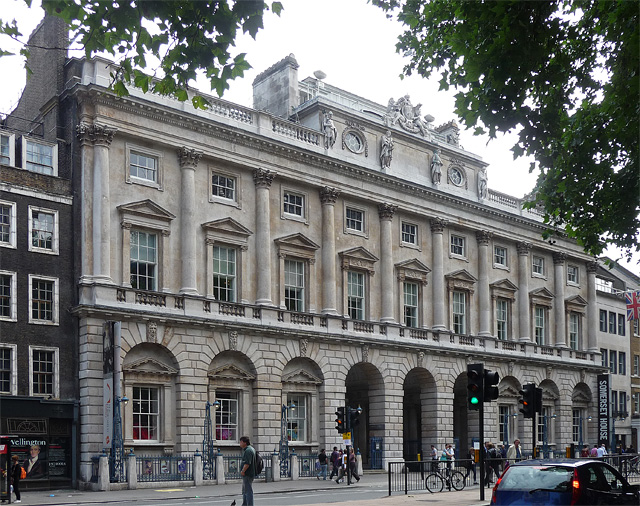
    Somerset House is a 1776 Neoclassical complex designed by Sir William Chambers to house administrative departments like the Navy Board. Originally constructed to rise directly out of the Thames, it still retains massive arched water gates once used for boat access. The central stone courtyard now features 55 fountains rising from the paving, transforming each winter into an ice rink.

    Architect: William Chambers · Style: Georgian architecture … · Wikidata

  8. Royal Courts of Justice in London
    This image was produced by me, David Castor (user:dcastor). The pictures I submit to the Wikipedia Project are released to the public domain. This gives you the right to use them in any way you like, without any kind of notification. This said, I would still appreciate to be mentioned as the originator whenever you think it complies well with your use of the picture. A message to me about how it has been used would also be welcome. You are obviously not required to respond to these wishes of mine, just in a friendly manner encouraged to. (All my photos are placed in Category:Images by David Castor or a subcategory thereof.) / CC0

    8Royal Courts of JusticeAttraction

    The Royal Courts of Justice presents a Victorian Gothic Revival design completed in 1882 by George Edmund Street. Street won the public commission but died from project stress before his forest of stone towers, 35 million bricks, and 1,000 rooms were finished. Above the main entrance, a sculpted figure of Jesus stands flanked by King Solomon and King Alfred the Great.

    Built: 1882 · Architect: George Edmund Street · Style: Gothic Revival · Wikidata

  9. The Old Bank of England in London
    Ewan Munro from London, UK / CC BY-SA 2.0

    9The Old Bank of EnglandBuilding

    The Old Bank of England on Fleet Street opened in 1888 as a specialized branch designed by Sir Arthur Blomfield for legal professionals. Built with thick Italianate masonry and vaulted ceilings to project financial security, the building now operates as a pub. Its basement retains original high-security vaults once used to safeguard gold reserves and legal documents for the nearby Inns of Court.

    Architect: Arthur Blomfield · Style: Italianate architecture · Wikidata

  10. Temple Church, London in London
    It's No Game / CC BY 2.0

    10Temple Church, London

    Temple Church features a distinct twelfth-century circular nave built by the Knights Templar to echo Jerusalem's Church of the Holy Sepulchre. The floor displays life-sized stone effigies of medieval knights, including William Marshal, the 1st Earl of Pembroke. Extensively restored after 1941 Blitz damage, the building combines its Romanesque rotunda with a pointed-arch thirteenth-century chancel.

    Built: 1185 · Style: Romanesque architecture · Named after: Knights Templar · Wikidata

  11. St Bride's Church, City of London in London
    Johan Bakker / CC BY-SA 3.0

    11St Bride's Church, City of London

    St Bride's Church was rebuilt by Sir Christopher Wren after the 1666 Great Fire of London and is known as the journalists' church. Its 226-foot tiered spire inspired baker William Rich in 1703 to model the design for the traditional tiered wedding cake. Beneath the airy sanctuary, the crypt preserves ancient ruins of Roman structures alongside a medieval chapel.

    Built: 1670 · Architect: Christopher Wren · Style: English Baroque · Wikidata

  12. OXO Tower in London
    Acabashi / CC BY-SA 4.0

    12OXO TowerBuilding

    The OXO Tower was converted from a nineteenth-century power station during the 1920s for the Liebig Extract of Meat Company. To bypass local bans against skyline advertising, architect Albert Moore shaped the illuminated upper windows into circles and a cross to spell out the OXO brand. Rescued from demolition in the 1980s, the Art Deco landmark now contains design studios and a rooftop restaurant.

    Style: Art Deco · Wikidata

  13. Royal National Theatre in London
    Aurelien Guichard from London, United Kingdom / CC BY-SA 2.0

    13Royal National Theatre

    The National Theatre on the South Bank is a 1976 Brutalist building designed by Sir Denys Lasdun using raw, board-marked concrete. Lasdun configured the public walkways as interlocking terraces intended to function as an open extension of the riverfront. Housing the Olivier, Lyttelton, and Dorfman theaters, the complex was once compared by Prince Charles to a nuclear power station.

    Built: 1963 · Wikidata

  14. Westminster Bridge in London
    Berit from Redhill/Surrey, UK / CC BY 2.0

    14Westminster BridgeBuilding

    Westminster Bridge, completed in 1862 by Thomas Page, is central London's oldest surviving road bridge across the Thames. Its cast-iron spans are painted green to match the leather upholstery of the nearby House of Commons, contrasting with red-painted Lambeth Bridge. Its Gothic decorative metalwork was designed specifically to echo the architectural style of the adjacent Parliament buildings.

    Architect: Thomas Page · Named after: Westminster · Wikidata

  15. Palace of Westminster in London
    Terry Ott from Washington, DC Metro Area, United States of America / CC BY 2.0

    15Palace of WestminsterCastle

    The Palace of Westminster was rebuilt in the Perpendicular Gothic style by Sir Charles Barry following a catastrophic 1834 fire. Augustus Pugin created the elaborate interiors and the iconic Elizabeth Tower, which houses the 13-ton Big Ben bell. Behind its Anston limestone facade decorated with English sovereigns lies an advanced Victorian system of early air conditioning and iron roofs.

    Architect: Charles Barry, Jr., Augustus Pugin · Style: Perpendicular Gothic … · Wikidata

  16. Westminster Abbey in London
    Σπάρτακος / CC BY-SA 3.0

    16Westminster AbbeyChurch

    Westminster Abbey has served as the coronation site for British monarchs since 1066, with its present Gothic structure started in 1245 under Henry III. The western towers were completed centuries later in the 1740s by Nicholas Hawksmoor to complement the original medieval stonework. Inside the burial grounds of seventeen monarchs stands the Henry VII Lady Chapel, known for its intricate stone fan vaulting.

    Built: 901 · Style: Gothic architecture … · Named after: Saint Peter · Wikidata

  17. St. James's Park in London
    No machine-readable author provided. Gerry Lynch~commonswiki assumed (based on copyright claims). / CC BY-SA 3.0

    17St. James's Park

    St. James's Park evolved from a medieval marsh for lepers into Henry VIII's royal deer park before John Nash redesigned it in the 1820s. Its Blue Bridge over the lake offers dual vantage points toward Buckingham Palace to the west and the turrets of Whitehall to the east. Descendants of pelicans presented to King Charles II by the Russian Ambassador in 1664 still reside near Duck Island.

    Built: 1603 · Wikidata

  18. Victoria Memorial in London
    Neil Owen / CC BY-SA 2.0

    18Victoria MemorialMonument

    The Victoria Memorial was unveiled in 1911 at the end of The Mall, designed by Sir Aston Webb and sculpted by Sir Thomas Brock. The central pylon is carved from 2,300 tons of white Carrara marble and topped with a gilded bronze Winged Victory. Marble groupings around the queen represent charity, truth, and justice alongside imperial industries such as shipbuilding and agriculture.

    Built: 1901 · Architect: Aston Webb · Style: Beaux-Arts · Named after: Victoria · Wikidata

  19. Buckingham Palace in London
    Diliff / CC BY-SA 3.0

    19Buckingham PalaceCastle

    Buckingham Palace originated as an 1703 townhouse for the Duke of Buckingham before John Nash transformed it for George IV. The familiar East Front with its central balcony was refaced with Portland stone in 1913 by Sir Aston Webb. Today, the Royal Standard flies from the roof when the sovereign is inside, replaced by the Union Jack whenever the monarch is away.

    Built: 1703 · Architect: William Winde, John Nash · Style: Georgian architecture … · Wikidata

Download the app

This public page shows a preview. The full route, all content, and navigation are available in CityTour AI.

Cities nearby

Discover self-guided tours in nearby cities.

Frequently asked questions

The key answers before you start.

Is this a self-guided audio tour?

Yes. In the CityTour AI app (iOS and Android), this is a self-guided audio tour for London — start anytime, at your own pace, with map, stops, and audio narration.

What will you see on this tour?

On this tour you'll see, among others, Trafalgar Square, Admiralty Arch, Horse Guards Parade, Banqueting House, Victoria Embankment Gardens, Cleopatra's Needle and more sights.

Where does the tour start?

The route starts at Trafalgar Square and ends at Buckingham Palace. You can start anytime — the app guides you to the first stop.

How long does the tour take?

About 180 minutes for 19 stops — at your own pace, with breaks whenever you like.

How much does the tour cost?

This tour costs 30 credits. The exact price depends on the pack you buy and your country — roughly $10.

Is it an outdoor tour — are entry tickets included?

Yes, it's an outdoor tour: the sights are viewed from the outside. Entry tickets are not included, and step-free access cannot be guaranteed.

Is the audio guide available in my language?

The tour and audio guide are available in English, Deutsch, Français, Español, Italiano and 9 more languages. You pick your language in the app.

Can I use the tour offline?

Yes. Tours can be used offline.

Can I ask the AI questions along the way?

Yes. At every stop you can ask the AI directly if you want to know more or didn't understand something.